
Start an Albany Residents Directory Search
A clear question saves hours. Ownership, occupancy, a court matter, a family connection, and an old address each point to a different source. A property result yields a parcel and a recorded owner. It does not prove the owner sleeps there. A directory or census entry can place a household at an address for a stretch of years. Even that leaves some adults unlisted.
Start with your strongest fact. A known address points to the county property tools and parcel map. A person search should first pin down the full name, spelling variants, time period, and any known relationship. Chasing a past household means setting a target year. Expect regional Oakland-Berkeley directories rather than an Albany-only volume. Following that order keeps the trails separate while one result guides the next.
- Write down the question, date range, name variants, and whether the goal is ownership, occupancy, family history, or record verification.
- Use Alameda County Property Assessment Information or the county tax search for a known Albany street address or APN, then save the parcel identifier.
- Compare the result with a recorded deed or court filing. Treat the assessor, tax, and permit records as evidence of a defined fact, not as a complete household list.
- Use the appropriate court, license, business, vital, or historical index when the question is about a person rather than a parcel.
- Request an existing record from the Albany City Clerk or the responsible county office when the needed file is not online.
A clean trail records the what, where, and result of each search. Log every step. Claiming "not located under these terms" is far safer than asserting a person never existed.
Where Albany Resident Records Are Kept
Albany's own files start with the City Clerk and city departments. The durable trails live with the county. Property, deeds, taxes, elections, vital records, and most court files all sit in Alameda County. Its seat is Oakland. That split matters. Stop at a city staff directory. You miss the records tying a parcel or case to a person.
Each office answers a narrow question. The Albany public-records page explains how to request existing city records. The Alameda County Clerk-Recorder Official Public Records index is party-based. The assessor and tax tools work best once an address or parcel is known.
Albany City Clerk
City-created administrative files, council material, rosters, and request routing.
City Hall, 1000 San Pablo Avenue, Albany, CA 94706
Alameda County Clerk-Recorder
Deeds, liens, releases, maps, official filings, and county certificates.
Electronic index from 1969; older records require Oakland microfilm research.
Alameda County Assessor
APN, situs address, parcel facts, assessment data, and map links for known properties.
PropInfo is an address or parcel bridge, not an unrestricted owner-name browse.
Alameda County Elections
Individual voter confirmation, district details, and statutory file-request routing.
Personal voter status is different from a public street roster.
Fallbacks differ by custodian. The recorder offers online indexing for newer records and microfilm at 1106 Madison Street, Oakland, for earlier years. The City Clerk takes focused CPRA requests, and the courts provide public terminals plus mail searches. Follow the custodian, not the first search box.
An Albany Parcel Does Not Name Every Resident
The classic mistake is reading an owner as an occupant. PropInfo links an address to an APN and assessment facts. A tax record names a taxpayer or mailing address. A deed lists grantors and grantees. No field lists everyone who slept there.
Permits and planning packets add another layer: an application may name an owner, architect, engineer, contractor, or applicant. A council or planning attachment can preserve useful address history. Those names describe a project relationship. Treat them as such, not as proof of residence.
| Parcel or APN | A county identifier that links maps, assessment data, taxes, and recorded legal descriptions. |
|---|---|
| Situs address | The physical location used by the assessor or permit system; it is not the same as a mailing address. |
| Mailing address | Where an owner or taxpayer receives notices; it may belong to an agent, trust, or different property. |
| Occupant clue | A directory, census, obituary, or lawful personal confirmation that places someone at an address for a stated period. |
Two independent records beat one shared address. Preserve any contradiction. A deed can establish title while a directory places an earlier household, and both facts can hold without identifying the same person.
Albany Court Searches Use Two Portals
Alameda Superior Court splits public access by case family, with eCourt covering civil, small claims, family, probate, mental-health, and adoption categories where public. Odyssey handles criminal cases. Its reach starts with activity in 2005. A blank result has many explanations. It may mean the wrong portal, a restricted case, an older criminal matter, or a spelling variation.
The Alameda court records page is the routing point. From it come online search, courthouse terminals, mail requests, and the Records Unit. eCourt accepts a party name, case number, case type, and filing-date range. The public view shows a register of actions, hearings, and document labels. Sealed or confidential material stays out of view.
| Portal control | What to enter | What it helps separate |
|---|---|---|
| eCourt party search | First, middle, last, or business name; case type; filing-date range | Civil, family, probate, and related public case categories |
| eCourt case search | Exact case number | The cleanest route to a known matter and its register |
| Odyssey criminal search | Party name or case identifiers | Public criminal case information, not document images |
| Courthouse terminal or mail search | Division, party, case number, and date details | Older or harder-to-route files when the web path is incomplete |
Public terminals are free for viewing. Files stay on site. The court does no research by phone or email. Copy, search, and certification fees follow the current court schedule. Never treat a case-party match as proof of identity. Compare chronology and other lawful records first.
One caution belongs in the workflow. The court warns of impostors posing as Pretrial Services. They demand GPS-monitoring payments, a 2026 alert. Verify any caller through the court's independently obtained records page. Do not use a number the caller supplies. For a visual starting point, the official court-records access page displays the court's division and access guidance.
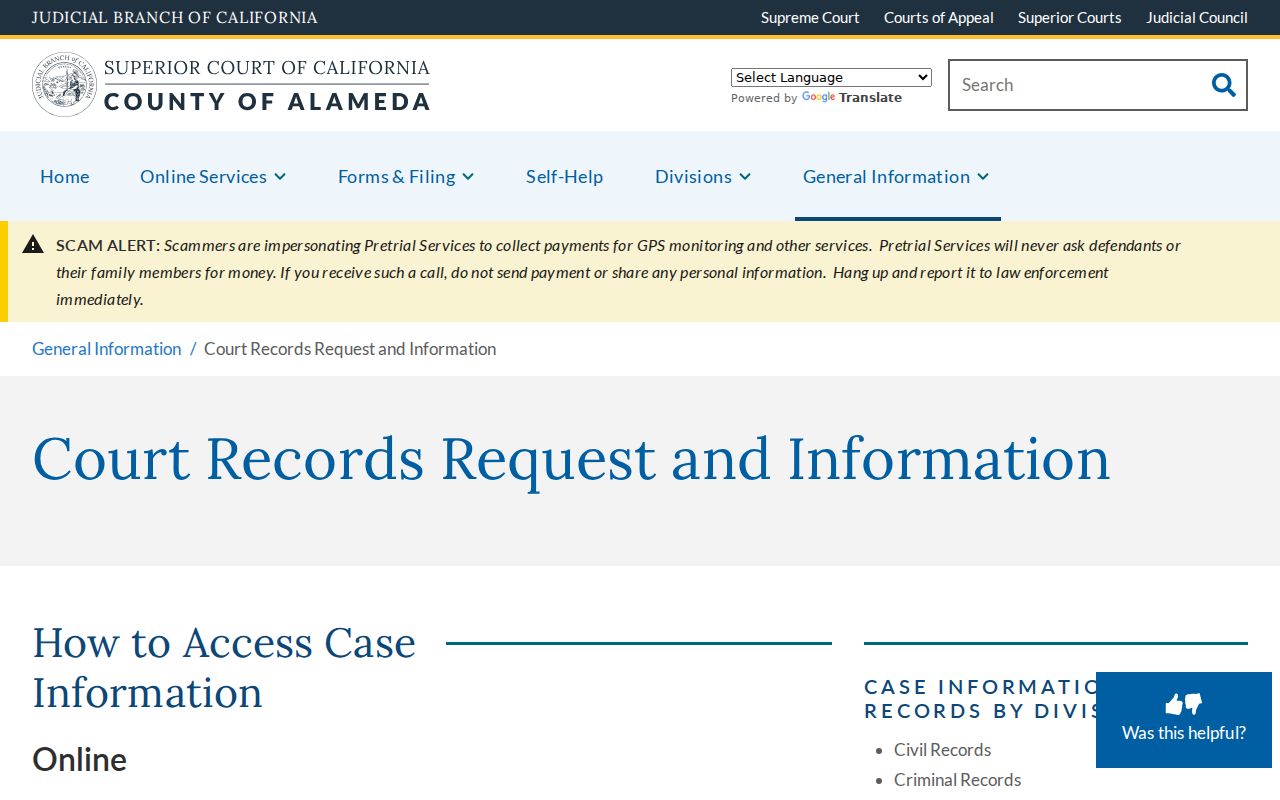
That guidance is the point. Portal choice comes before any conclusion about a name.
California Voter Rolls Have Narrow Access
California voter records are not built for casual browsing. My Voter Status and Alameda County's My Voter Profile verify one person at a time. A voter can confirm registration, districts, polling place, vote-by-mail status, language preference, sample ballot details, and elected officials. None of that produces a list of Albany neighbors.
Elections Code §§2187 and 2194 govern file requests. Requests must serve election, scholarly, journalistic, political, or governmental purposes. The statewide application asks for the requester, geography, purpose, security plan, intended use, signature, and delivery choice. Private or commercial browsing does not qualify. Signatures and Social Security numbers stay out. Driver-license and state-ID data are excluded as well.
The California voter-status lookup shows an individual check in action. Enter your own details, pick Alameda County, and read the status as current to the display date. Without a qualifying purpose, deeds, permits, city directories, court indexes, or a direct conversation are the honest substitutes.
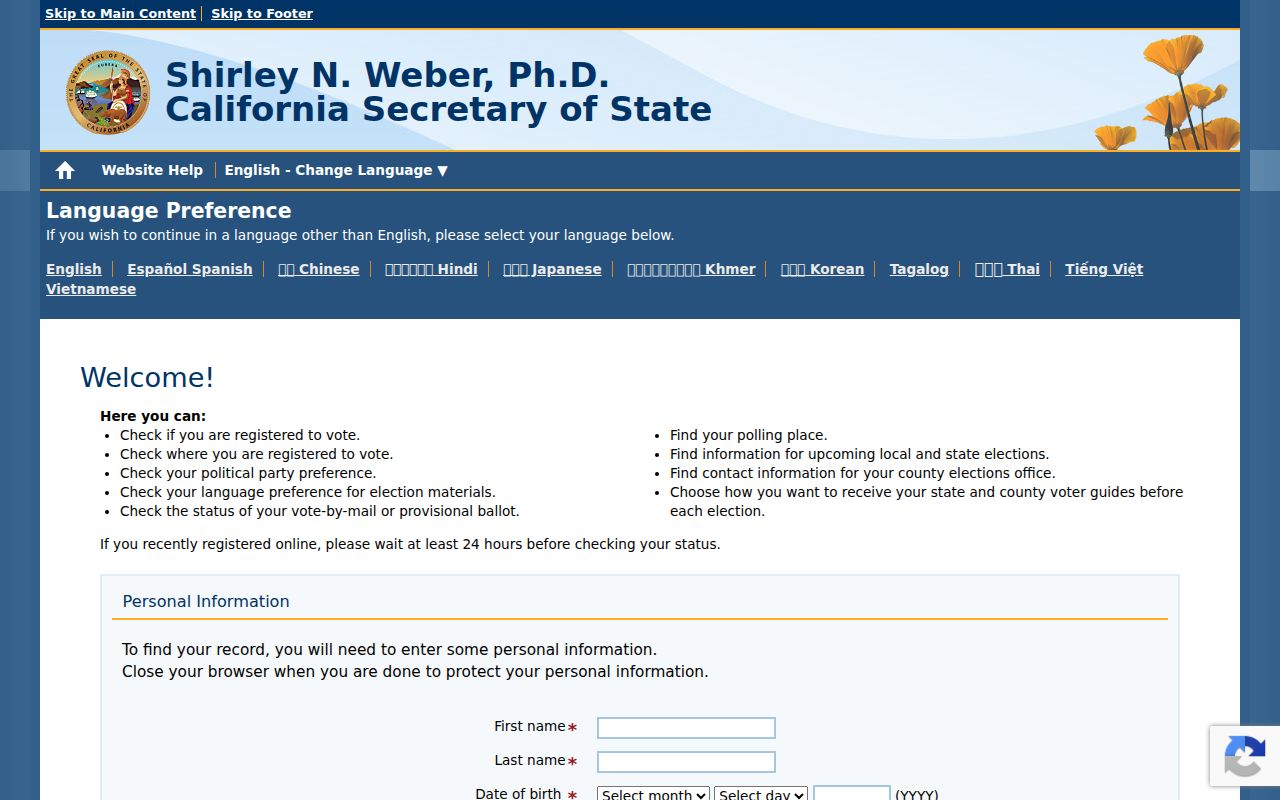
This voter-status capture belongs to individual verification, not to a street-by-street Albany residents directory.
Use the narrow route. Public status tools do not authorize a block roster. Do not use voter data to stalk, harass, threaten, or publish sensitive details about a person.
Which Albany Resident Sources Are Current
No single official roster lists everyone who lives in Albany. Each source is built for one purpose. Tax and property systems lead with an address. The recorder indexes by party name instead. Voter tools only confirm your own status or serve a qualifying purpose. City directories cover public employees rather than private households. State license and business files verify a professional or filing tie, not where someone lives.
| Source | What it can establish | Custodian | Access path |
|---|---|---|---|
| PropInfo / parcel viewer | APN, situs, map, assessment facts, and related parcel links | Alameda County Assessor | Known address or parcel search |
| Secured or supplemental tax search | Tax parcel, bill period, installments, and payment status | Alameda Treasurer-Tax Collector | Address or APN search |
| Official Public Records index | Indexed parties, instrument, type, date, and legal-description trail | Alameda County Clerk-Recorder | 1969-present online; earlier microfilm |
| My Voter Status / Profile | A voter's own registration and district information | California and Alameda elections offices | Individual verification |
| City directory | Public staff roles and official contacts | City of Albany | Online staff directory |
| License, business, or unclaimed property result | A filed status, entity link, credential, or holder-reported address fragment | California state offices | Official name-based lookup |
Never trust a "current" label alone. The date and scope always matter more. A 2026 court result, a live tax bill, a directory entry collected before publication, and a 1998 photo caption each prove something different.
From Albany ZIP 94706 to an APN
ZIP geography can narrow a mail address, but a parcel record must answer the land question. Albany's principal postal ZIP is 94706, while 94707 and 94710 can appear in regional routing near the Berkeley edge. The Alameda County property information hub links assessment, maps, taxes, and parcel tools that turn a complete street address into an APN.
Standardize the address through USPS first, then use the county parcel viewer to confirm incorporated Albany, the APN, adjoining parcels, and the relevant map layers. Compare the assessor situs against the mailing label before you trust either one. For historical work, move from the APN to the deed's legal description, so the record trail stays intact even when a postal city, ZIP, or street spelling shifts.
Remember that demographic counts from a ZIP Code Tabulation Area use a different denominator than the City of Albany. Keep Census place facts, USPS delivery facts, and GIS jurisdiction facts in separate notes. A ZIP can filter well without being a city boundary.
Albany's CPRA Request Is the Offline Route
The California Public Records Act covers unpublished city files. Government Code §§7920.000 et seq. governs. It reaches existing, reasonably described public records. An agency generally has 10 calendar days to decide whether responsive disclosable records exist, with a written extension of up to 14 days in unusual circumstances. That clock sets only a determination deadline. Production can lag well past it. Name the department first. Add the address or project, the record type, and the date range. The City Clerk does not have to create a new list or answer a question in place of producing an existing record. Building, planning, public works, council, and administrative files can be withheld or redacted under exemptions. Statewide, the California Attorney General's CPRA overview sets the frame. The offline path is not a failure of the Albany residents directory; it is the proper fallback. Reach for it when a permit attachment, planning packet, or city correspondence is not indexed.
The CPRA image points to the statewide request framework, and the city page stays the place to name which Albany-held records you want from the City of Albany.
A Late-1800s to 2001 Albany Photo Trail
The Library Historical Photograph Collection is an Albany gem. It offers some of the most local clues to anyone tracing a street or family. Alameda County Library describes images spanning the late 1800s through 2001. Homes, schools, and street scenes appear. So do the Peralta Park Hotel, notable residents, and civic events. A single photograph can date the physical setting of an address. It may not name every occupant, but it anchors the street directory record in time.
The genealogy shelves sit close by. Ancestry Library Edition works in-library only. It covers census images and indexes, maps, biographical material, Social Security Death Index records, and military collections. HeritageQuest reaches census and local-history material remotely once you authenticate with a library card. Fold3 rounds things out with military records. Each finding still deserves a note of its source type and date. For family history, that habit keeps an Albany residents directory search honest.
The Alameda County Library history and genealogy page is the sensible first stop. It lays out the collection and its access conditions.
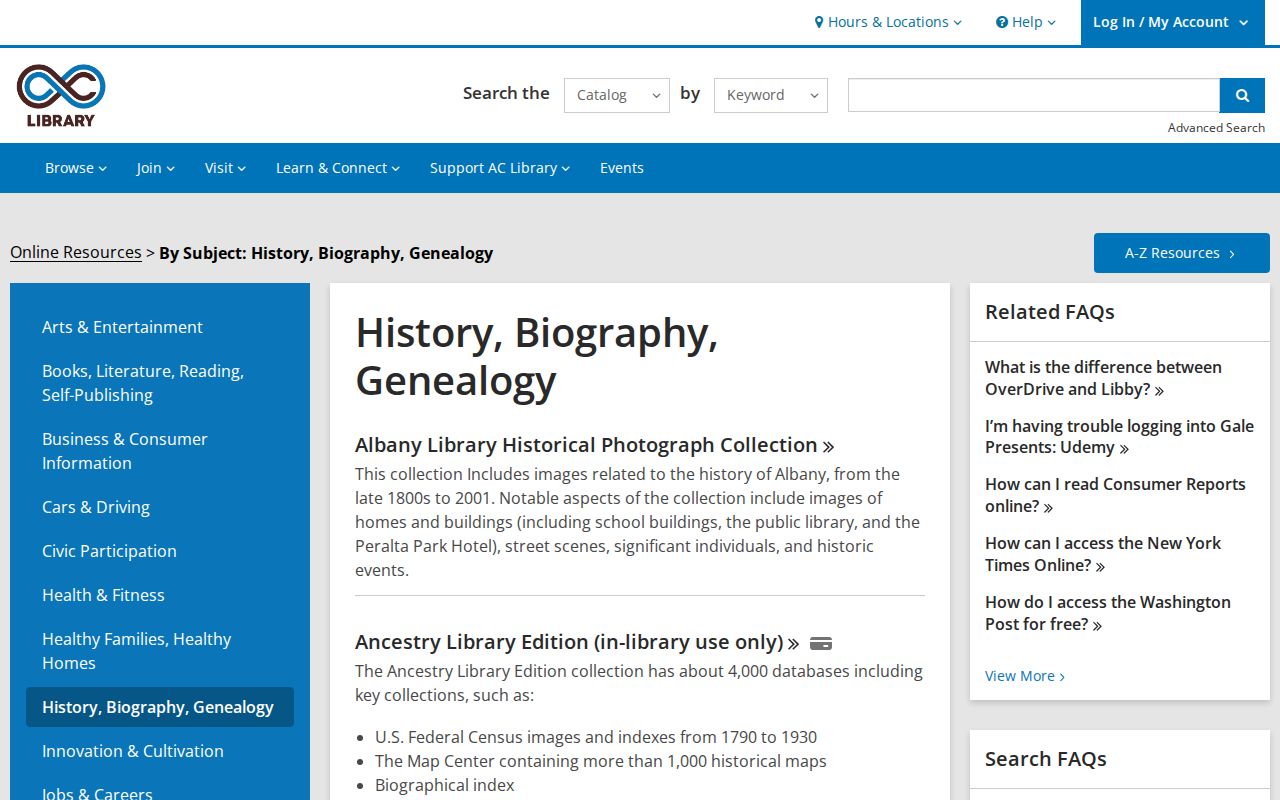
The library resource image ties a local visual record to the census and genealogy shelves. Those shelves often explain who lived around the scene the camera captured.
Albany's Regional Directory Shelf
Albany never had its own year-by-year printed city directory. That is the honest starting point for this shelf. Instead, historical Albany research leans on regional Oakland-Berkeley telephone and city directories. Each edition opens with a geographic preface. That preface is where you confirm what the volume actually covers.
Berkeley Public Library links a verified 1916 Oakland-Berkeley Telephone Directory. California Revealed hosts a digitized Polk's Oakland directory. It folds in Alameda, Berkeley, Emeryville, and Piedmont. Oakland Public Library, meanwhile, documents its Polk holdings. It also lists telephone and Haines San Francisco City & Suburban Criss-Cross holdings. A regional title that skips Albany still is not proof of absence. But it cannot be assumed to cover the town either. Work the locality pages, the street guide, and the address section before giving up. A single entry can yield a name. It can also yield an occupation, a spouse clue, a telephone subscriber, or a residence snapshot. A Haines volume flips the search around, moving from address to name. For the full trail, see the Albany city directory reference. There these shelves and reading rules are the main story.
Safe at Home Can Change the Address Trail
Some addresses in Albany are deliberately hard to trace. California Safe at Home gives eligible people facing safety risks a substitute mailing address. It also provides mail forwarding and an agent for service of process. Confidential voter registration comes with it too. Elections Code §2166.5 adds its own shield for confidential voter status. These protections explain why a lawful residents-directory search can come back without the address you expected. They are not an obstacle to defeat.
The program cannot reach back and erase old public records, though. A deed's legal description can still pinpoint a property. That holds true even after a mailing address is substituted. Recorded documents may also redact protected identifiers. The Secretary of State Safe at Home guidance lays out eligibility, substitute-address limits, and voter protections in plain terms.
Respect protected-address programs, sealed files, juvenile records, and confidential court or vital records. Verify a record with its custodian and never use an address trail to stalk, harass, or harm another person.
Albany Record Terms Worth Knowing
Short labels can hide large differences in Albany records work. These terms keep an Albany residents directory search tied to the record that actually supports the claim.
- Roll
- An administrative list, such as an assessment or election record, created for a defined public purpose.
- Index
- A finding aid that points to a record. It is not the same as the underlying deed, filing, or certificate image.
- Parcel
- A mapped unit of land identified by an APN and related legal description; one building or parcel does not equal one household.
- Criss-cross directory
- A reverse directory arranged by address or phone rather than only by surname.
- Certified copy
- A copy issued by the custodian with formal certification; an online index or informational copy does not automatically carry that status.
Labels drift fast in records research. Writing the definition beside each search result keeps the discipline honest. That habit prevents a tax entry from being called a deed, a directory clue from being called a current resident, or a voter status result from being called a public roll, and it keeps every Albany lookup anchored to its real source.
Albany's 2026 Records Changes
A few live changes are reshaping how an Albany residents directory search gets done. CDPH confirms that certified-copy fees rose on January 1, 2026 under AB 64. Birth certificates now cost $31, death certificates $26, marriage certificates $19, and dissolution certificates $18. That figure is a state vital-record fee. It is not a promise about any county copy or court file.
Court access has shifted too. Alameda migrated family, probate, mental-health, and adoption categories into eCourt in 2023. Odyssey has handled criminal activity since 2005. Older instructions that still point to DomainWeb can misroute a search. Start from the current court records page and the correct division. Do not treat a blank result as final.
California's Delete Act is phasing in through the California Privacy Protection Agency. A broker deletion request can pull a commercial copy. It leaves a government deed, tax record, or other source record untouched. Keep the custodian and the access date beside every result you save.