
Where Albany Previous Residents Leave Records
A house history needs a source for ownership and a separate source for occupancy. Alameda County's recorder indexes parties to official documents. Assessment and tax tools bridge a known Albany address to an APN, or assessor's parcel number. Regional directories and federal census schedules can show people at a place, while city permits and photographs add evidence about work or the building itself. The coverage table keeps those roles distinct before a search begins.
| Source | Years It Covers | Where Held | What It Shows |
|---|---|---|---|
| Electronic recorder index | 1969-present | Alameda County Clerk-Recorder online index | Indexed parties, document type, date, and instrument number |
| Official records and microfilm | 1853-1968 | 1106 Madison Street, Oakland | Manual grantor-grantee research and recorded documents |
| Assessment and tax systems | Current and recent data | PropInfo, parcel tools, and county tax search | APN, situs, values, map links, and tax information |
| Regional directories and telephone books | 1916 example; editions vary | Berkeley and Oakland libraries; California Revealed | Names, addresses, subscribers, and household clues |
| Federal census schedules | Public through 1950 in 2026 | NARA, Ancestry, and FamilySearch | Household members, relationships, ages, and places |
| Permits, planning, and photographs | Dates vary by record set | City of Albany and Alameda County Library | Project activity, building context, and visual clues |
Start with the source that matches the question. A current parcel question begins with assessment and the latest deed. A household question begins with a regional directory or census. A change to the building calls for permits, planning packets, Sanborn maps, or photographs. The former resident trail becomes persuasive when two independent records agree on both person and time.
The Alameda County Clerk-Recorder public-records hub identifies the county office that holds deeds, official documents, and county certificates. The captured reference below is a useful reminder that a local Albany search is usually handled through the county in Oakland.
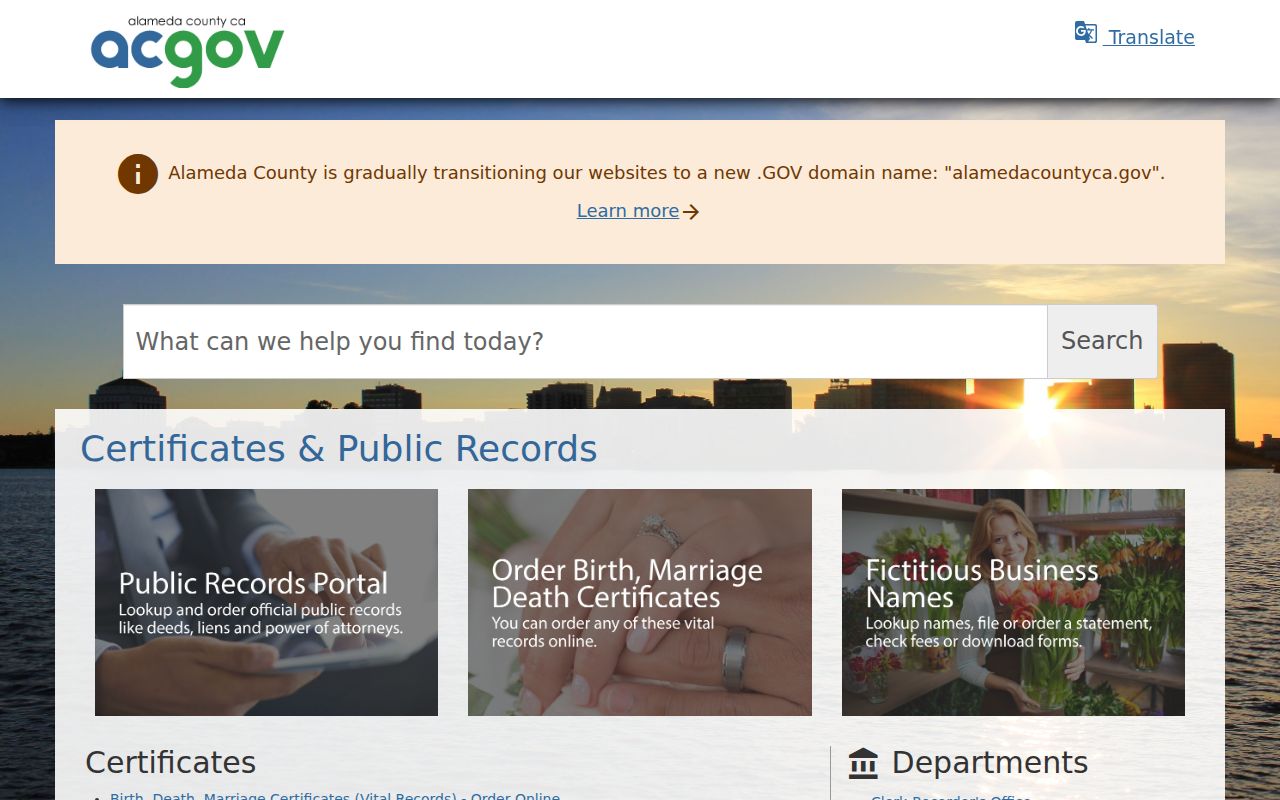
The county record image belongs in the ownership portion of a house history. It does not, by itself, identify every person who occupied the property.
Albany Previous Residents Cross the 1969 Line
The most important date in an Alameda address search is 1969. Official records reach back to 1853, but the electronic name index begins in 1969. A search for previous residents can therefore look complete while silently stopping before more than a century of county filings. Search the online index for the later chain, then plan an in-person microfilm search for the earlier period at 1106 Madison Street in Oakland.
The Alameda County Official Public Records research page states the coverage break and the grantor-grantee method. The index is reference information. It may contain a trust, business, former name, middle initial, or misspelling, and the office does not authenticate the underlying claim from the index alone.
Coverage checkpoint. A blank online result is not a blank history. Widen the name and date search, then move to the Oakland microfilm counter when the chain reaches pre-1969 records.
Trace Albany Previous Residents Through Deeds
The backward deed chain starts with a known parcel, not a guessed surname. Search the address in county assessment tools, capture the APN and map reference, and retrieve the current vesting deed. The deed names the grantee, or buyer receiving the interest, and the grantor, or party transferring it. Search that seller as a grantee in an earlier period. Repeat the handoff while comparing the legal description, parcel map, and instrument details instead of matching names alone.
Alameda County PropInfo is the known-property bridge. A tax search can add address or parcel-number detail, but assessment and tax data are administrative records, not title proof. The recorded deed is the transfer evidence. Include spouses, trusts, middle initials, spelling variants, and every party role shown in the index.
- Enter the known Albany street address in PropInfo or the county property tools and write down the APN and assessor-map reference.
- Find the current vesting deed and record the grantee, grantor, instrument number, date, and legal description.
- Search the seller as a grantee in an earlier year range, then compare the legal description and parcel bridge.
- Repeat the seller-as-prior-buyer step, preserving trust names, spouses, initials, and spelling variants exactly.
- At the 1969 boundary, shift from web indexing to grantor-grantee microfilm and deed books at 1106 Madison Street.
- Overlay directories, census, obituaries, probate, and permits when the question changes from ownership to occupancy.
- Grantor and grantee
- The grantor transfers an interest; the grantee receives it. Their roles can change from one deed to the next.
- Chain of title
- A linked sequence of recorded transfers for one parcel, checked by legal description and map evidence.
- Legal description
- The lot, block, tract, map, or other land identifier in a deed. It is more stable than a postal address.
- Vesting deed
- The current recorded instrument used to identify the present ownership record before walking backward.
The Clerk-Recorder fee schedule explains copy channels and charges shown in the next image. Plain official-record copies are listed at $3.50 per page; certified copies are listed at $4.50 for the first page and $3.50 for each added page on the research page.
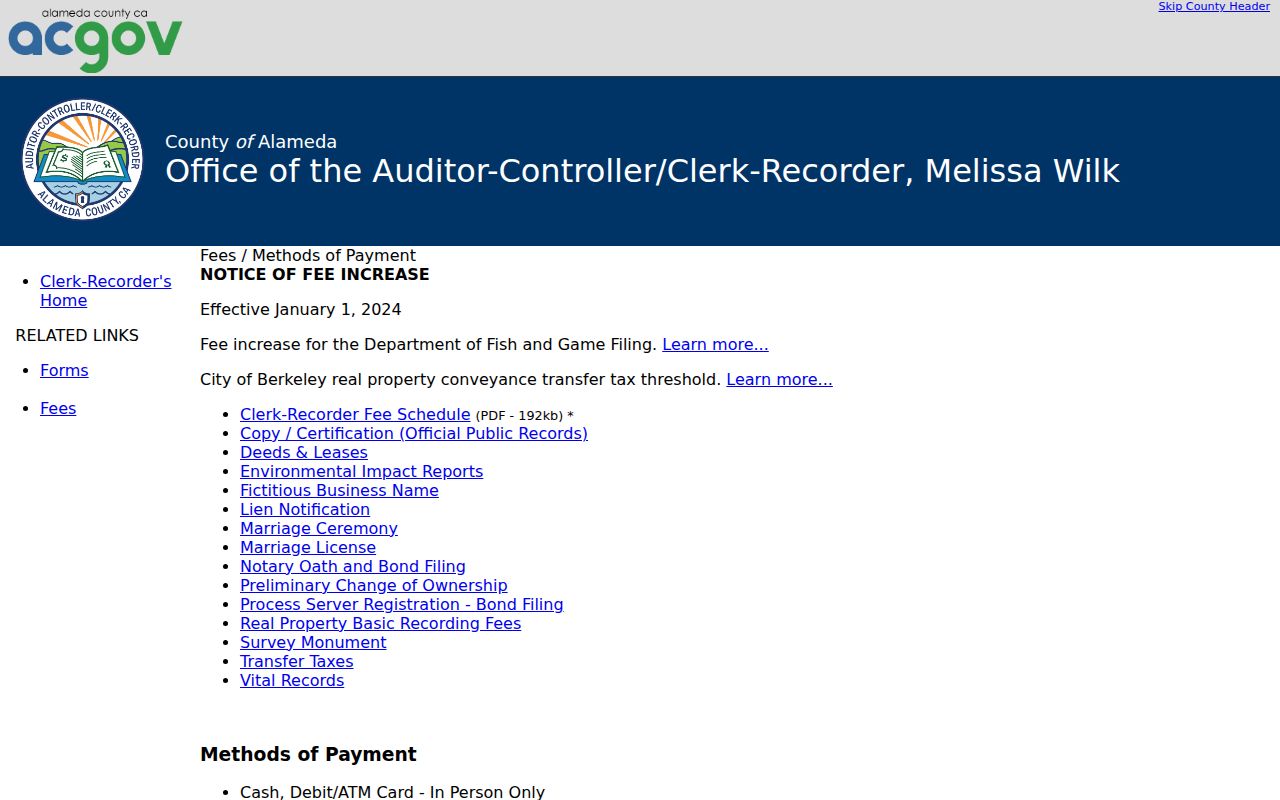
Verify the current PDF fee schedule before ordering. The fee image is a route to the custodian, not a substitute for the document image or certified record.
The official-record copy order form uses an instrument number, asks whether certification is wanted, and offers a copy quantity. Its online workflow displays a $2 convenience fee and a $1 additional certification charge for that order path.
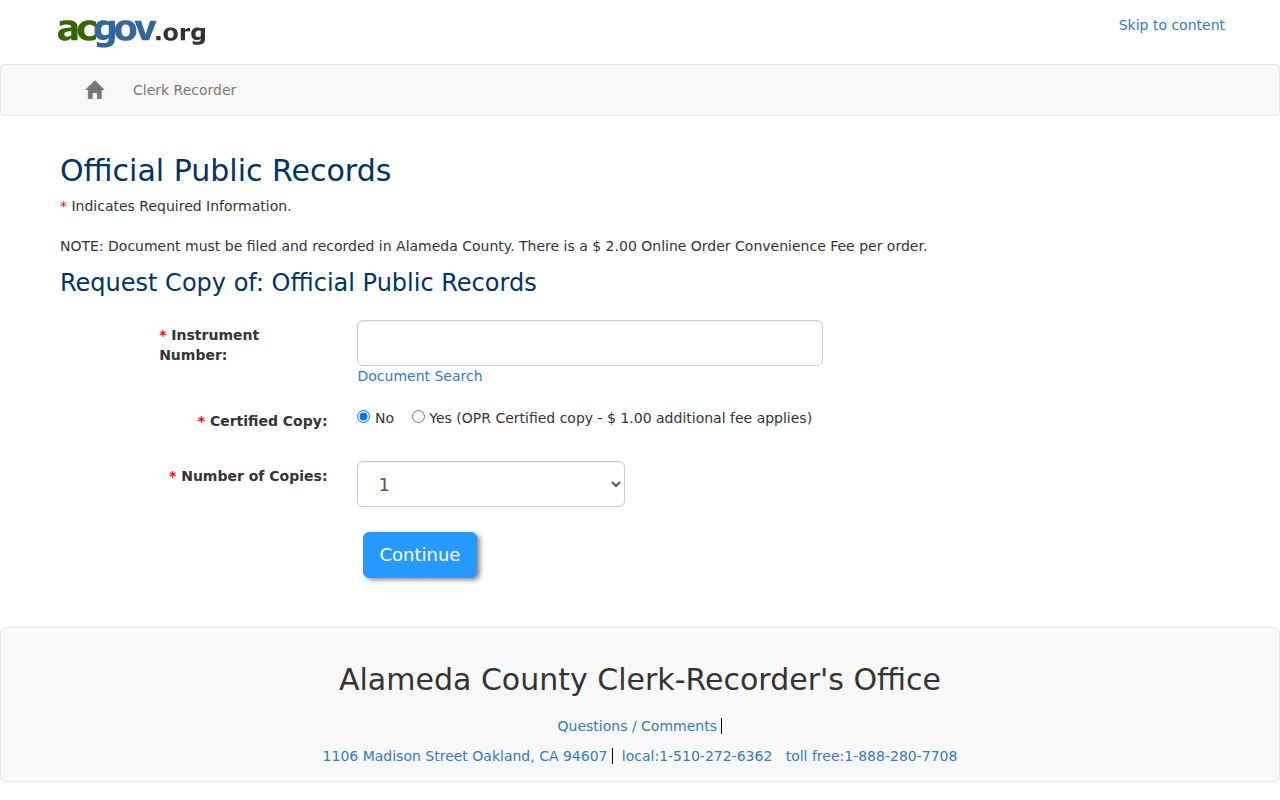
Mail orders can give the filing number, fictitious business name, or owner name, estimate pages, include a self-addressed stamped envelope, and pay in accepted U.S. funds. Credit cards are not accepted for mail or in-person requests; specified online orders accept MasterCard or Visa.
Legal Descriptions Keep Albany Past Residents Linked
Older deeds may not state the street address in the form used today. Lot, block, tract, map book and page, dimensions, and adjoining owners can carry the parcel across a postal change. APNs can also change after a subdivision, lot-line adjustment, condominium creation, or parcel combination. When the number shifts, bridge it with assessor maps, recorded maps, and the deed's legal description.
Record dates with care. Recording date is not always execution date or occupancy date. Separate grant deeds, quitclaims, trustee's deeds, deeds of trust, reconveyances, liens, and releases in the timeline. A deed of trust is financing security, not automatically a change in ownership. Transfers into or out of a revocable trust may change the indexed party without describing an ordinary move.
Note: An address can be stable in a directory while a parcel number changes, so legal description and map evidence should control the long chain.
Regional Directories Reveal Albany Previous Residents
Ownership is only one layer of previous residents. A regional city directory can show an occupant, spouse clue, occupation, business address, or widow notation at a particular issue date. A telephone book usually centers on the subscriber and service address. A Haines criss-cross reverses the direction and starts with a street number. Those formats answer different questions, and none should be treated as a complete household list.
Albany has no verified Albany-only printed run. Use the Oakland-Berkeley material and check each geographic preface. The 1916 Oakland-Berkeley Telephone Directory is a verified example. Polk's Oakland regional directory is digitized through California Revealed, while Oakland Public Library documents telephone, Polk, and Haines holdings. The historical collections and reading method are described in the Albany city directory research, which is the natural shelf for edition details.
When an entry disappears, search the next issue under a spouse or widow form, try a prior or next address, and test a street spelling. The gap can mean a move, death, marriage, omission, or missing edition. Record “not found,” “not published,” “edition unavailable,” and “place not covered” separately. That worksheet keeps a directory lead useful without overstating what the book proves.
Albany Past Residents and the 1950 Census
The 1950 federal census is the newest open enumeration in 2026 under the 72-year rule. It supplies a checkpoint for household members, relationship, age, birthplace, and address, while a city directory helps fill the years between decennial counts. A census household and a deed party are not the same unit. One shows people counted at a moment; the other shows an interest in land.
The National Archives census research guidance explains the public schedule framework. Pair the nearest directory and census dates, compare street names and household clues, and write down contradictions. If the household changes, look for an obituary, probate file, permit, newspaper notice, or a new directory entry before assigning a departure date.
- Set a known Albany address and date from a family paper, directory, deed, or photograph.
- Read the closest regional directory and capture every listed name, address, notation, and page.
- Compare the open census household, keeping ages and relationships separate from the directory wording.
- Search the next issue under spelling variants, spouse forms, nearby streets, and reverse-address pages.
- Use probate, obituary, deed, permit, or photograph evidence to explain the interval.
Permits and Maps Date Albany Past Residents
Albany Building Division and Planning & Zoning files can add a project address, owner, applicant, architect, engineer, contractor, work description, or hearing history where the record is public. A permit application may describe work that was never finished. A final inspection can date completion, but it does not establish the original construction date or the date a family arrived. City Council and planning packets may preserve more detail than a short permit summary, and a California Public Records Act request is the fallback for identifiable existing files.
The Albany Building Division entry point is the starting place for permit and inspection material. Planning files can be requested through the city records route when a project page is not enough. Compare application, issue, final, and plan dates with deed intervals. The same person may appear as an applicant or contractor without being a resident.
Sanborn fire-insurance maps add building footprint, stories, material, use, outbuildings, and old street labels when an Albany sheet exists for the needed year. They generally do not name occupants. The Library of Congress Sanborn collection is a map source, not a resident roll. Albany Library's Historical Photograph Collection extends from the late 1800s through 2001 and can show how a building or street scene changed.
Note: Permit dates prove recorded project activity, while photographs and maps supply physical context; neither one alone proves who lived at the address.
Custody Records and Albany Past Residents
A custody locator answers a different question from a previous-resident search. The California Department of Corrections and Rehabilitation locator covers state custody, using last name, first name, or CDCR number. Its result can show the person and custody details displayed by the state, but it does not prove that the person lived at an Albany address. Alameda County's sheriff locator covers county custody, a separate population. Keep both apart from deeds, directories, census, and probate.
The California incarcerated person locator is included as a distinct official lookup path for lawful family-location or safety research. The captured search surface below shows why a name or number result must not be folded into an address timeline without independent evidence.
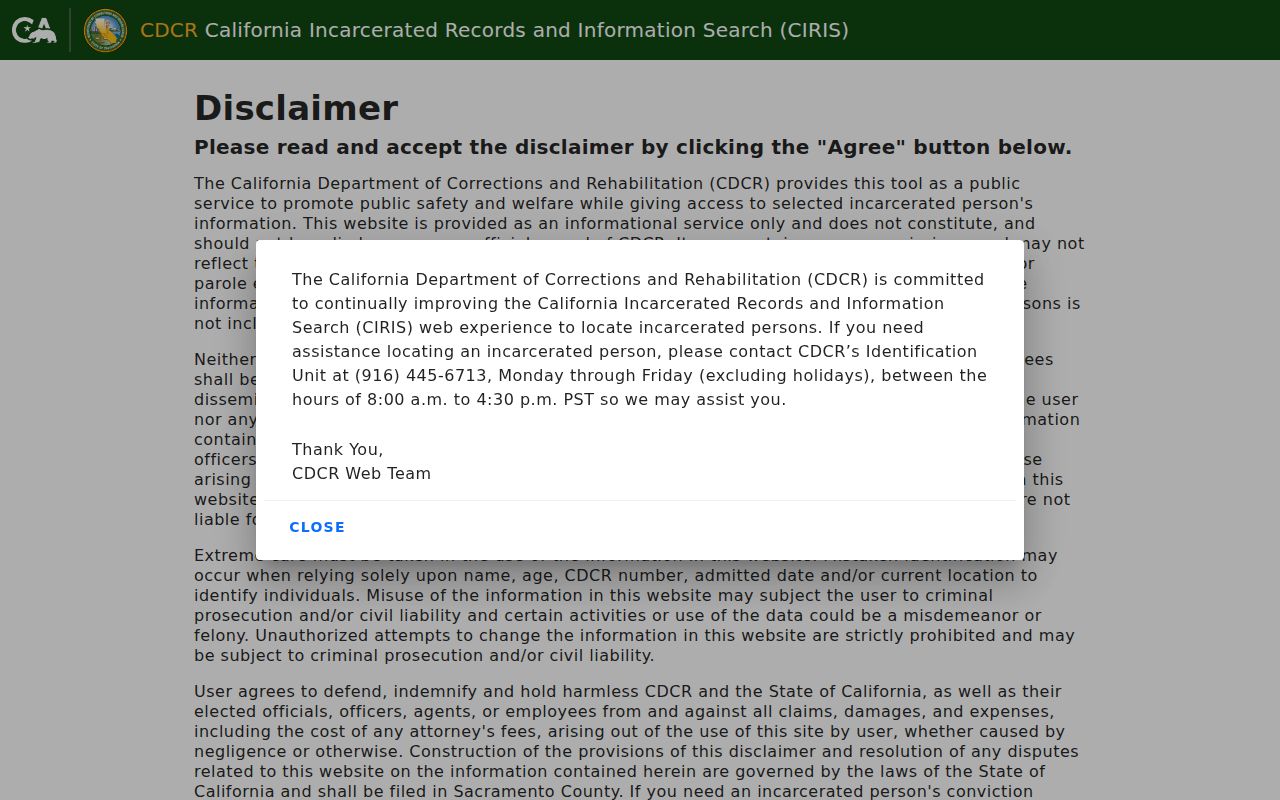
A custody result is time-sensitive and category-specific. It may help a family locate a person through the correct state channel, but it cannot replace a recorded deed, a regional directory entry, or a census household.
Verify Albany Previous Residents Lawfully
Before naming a past resident, keep provenance with each fact: custodian, collection, query, retrieval date, edition or filing coverage, spelling, and whether the result is an index or the underlying image. Require two independent records for a strong identity claim. A name match is a lead. A deed proves a recorded property interest. A directory proves a publisher-listed snapshot. A census proves an enumerated household. A photograph or newspaper mention supplies context.
Safety rules matter when a record touches a living person. California Safe at Home can provide eligible participants a substitute mailing address, mail forwarding, and confidential voter registration, and it may support deed substitutions within statutory limits. It does not erase old public records, and a legal description can still reveal a property location. Do not attempt to defeat protected-address, sealed-record, juvenile, voter-file, or registry limits.
Lawful house history. Albany previous-resident research is appropriate for family history, estate work, historical study, and personal curiosity. Do not use names or addresses to stalk, harass, threaten, impersonate, or expose a living person.
A careful conclusion says what the records support and what they do not. “Not located in this portal under these search terms on this date” is more accurate than declaring that a person or event never existed. The strongest Albany house histories preserve gaps, explain the 1969 access change, and keep ownership, occupancy, building work, and custody records in their proper lanes.