
How Albany Resident Lookup Records Line Up
A one-person search in Albany crosses several custodians because no single public roll proves every part of a person's story. Alameda County assessment data can connect a known parcel to an owner or taxpayer, while the recorded deed is the stronger source for a transfer. A court index can show a party, case type, or hearing history. Vital records establish events under access rules, and license or business filings confirm only the credential or entity relationship that was filed. The table keeps those questions distinct.
| Record | What It Confirms | Where to Search | Access |
|---|---|---|---|
| Assessment and parcel record | APN, situs address, tax area, use, assessed land and improvement values, and owner or taxpayer details where displayed | Alameda County PropInfo | Free known-address or APN search |
| Recorded deed or lien | Grantor, grantee, legal description, recording date, document type, and instrument number | Alameda County Clerk-Recorder index | 1969-present online; older microfilm in person |
| Voter status | A voter's own registration, districts, polling place, and ballot details | California My Voter Status or Alameda My Voter Profile | Individual verification, not a general roll |
| Civil, family, probate, or related court record | Party role, case category, filing dates, status, hearings, and public register events | Alameda Superior Court eCourt | Public search; copies and account features vary |
| Criminal case information | Public case information for cases with activity since 2005 | Alameda Superior Court Odyssey | Free case view; public documents are excluded |
| Vital record or index | Birth, death, public marriage, confidential marriage, or divorce event, subject to eligibility | Alameda Clerk-Recorder, CDPH, archives, or library databases | Indexes and copies have different limits |
| License, entity, or unclaimed property | Professional status, filed entity role, or a holder-reported old address fragment | California DCA, bizfile Online, or State Controller | Free public search; each result has a narrow meaning |
Begin with the record that matches the known fact. A parcel number is a better first key than a surname when a location is known. A court case number is cleaner than a common name. For a family line, begin with a confirmed death or obituary and then move through probate, census, directories, and deeds. A resident lookup becomes reliable when every result is labeled as ownership, occupancy, an event, a filing, or a lead rather than being treated as proof of residence.
Fix an Albany Resident Identity Before Lookup
Write down the full legal name, middle initial, suffix, earlier surname, approximate age, known Albany connection, and the time period before opening a portal. Keep Albany, California separate from Albany, New York in every query. A business address, mailing address, and physical residence can belong to the same person without being the same place. The same caution applies to an agent for service of process, a trustee, a permit applicant, and an owner shown on an assessment card.
Use an address-time anchor when one is available. A known parcel can be tested in PropInfo, the county tax search, a deed index, a city permit file, or a historical directory. A person who appears in a permit may be an applicant, architect, contractor, or owner without living at the site. A directory entry can show a household snapshot, but it may omit adults, reflect information gathered before publication, or use a regional mailing city. These distinctions keep an Albany resident lookup from turning a plausible match into a false identity.
Two-record rule. Require two independent records before stating that a name belongs to one Albany person. Record the custodian, search terms, date range, and whether the result is an index or an underlying document.
Albany Court Records: eCourt and Odyssey
Alameda County Superior Court divides public name research by case system. Civil, small claims, family, probate, and public portions of mental-health or adoption matters route through the eCourt Public Portal. Civil access moved to eCourt in 2021, and family, probate, mental-health, and adoption categories joined it in September 2023. DomainWeb was retired for those areas. The official Alameda court records instructions explain the current divisions and fallback channels.
| eCourt field or control | Type | Required | How it narrows an Albany resident lookup |
|---|---|---|---|
| Case Search / Calendar Search | Tabs | Choose one | Separates case information from hearing and calendar work |
| Case number | Text | No when using party search | An exact number gives the cleanest result |
| Party first, middle, last, or business name | Text | Search mode | Run spelling variants and preserve party roles |
| Case type or category | Selector | Optional | Limits civil, family, probate, and other migrated categories |
| Filing date range | Date pair | Optional | Reduces common-name collisions and broad result sets |
| Search / Clear | Buttons | Search action | CAPTCHA or terms may appear before results |
Criminal information remains in the Odyssey portal linked from the court records page. Odyssey is free, does not require registration, and covers cases with activity since 2005. It does not provide public criminal documents. For a nonconfidential copy, use the Criminal Record Requests route and the Records Unit rather than treating a case screen as the complete file. Public terminals at the courthouse are free for viewing. Civil files may be viewed at René C. Davidson Courthouse in Oakland and other designated courthouses; call the appropriate Records Unit first to learn where a file is held. The court accepts mail search or copy requests, but it does not research a file by phone or email. Files stay on the premises when viewed in person, and copy, search, or certification charges follow the current court schedule. Payment may be by check, credit card, or money order; never mail cash or card data.
What a public court result shows
An eCourt or Odyssey result is a starting record. It does not erase sealed, confidential, juvenile, adoption, mental-health, victim, or expunged material. Preserve the exact fields that made the result useful:
- case number, caption, case type or category, and filing date;
- party names, roles, related parties, and the case status;
- judicial officer, department, and upcoming hearing information;
- register-of-actions events, document title, and document file date;
- payment, download, or request availability shown by the portal;
- the search date, spelling used, and the access limits shown with the result.
Albany Resident Lookup Result Fields
Same-name collisions are common in a compact East Bay city tied to regional records. Keep middle names and initials, suffixes, former surnames, and business names in separate search passes. Narrow a court search with a filing range and case category. Compare the party role with a known date or public address in the filing. In a deed index, search the owner as both grantor and grantee, then widen the date range and check trusts, spouses, middle initials, and spelling variants.
Do not use the assessment roll as an unrestricted surname directory. PropInfo is designed for a known address or APN, and an owner or taxpayer may use a mailing address that is a post-office box, trustee, agent, or another property. A recorded deed is stronger for title than an assessment card, but title still does not prove occupancy. Directory, census, obituary, probate, and a person's own voter confirmation can add context, each with a different coverage gap.
Grade the evidence before making a conclusion. A certified vital record, signed court filing, recorded deed, official license record, or census schedule naming a household is direct evidence for its own fact. A directory entry, permit application, business statement, or unclaimed-property result is direct but time-limited. A photograph caption, newspaper note, or school record is useful context. A shared ZIP, an undated index snippet, or a name-only result is a lead, not identity proof. Write “not located in this portal under these terms on this date,” never “the person did not exist.”
Verify One Albany Name Across Records
For a practical one-person search, anchor the name first and then move from broad evidence to a record that can be checked at its source. Keep a short provenance note for each result. The sequence below is suited to a known Albany connection, but it also works for family research, an heir question, a former classmate, or a seller whose identity needs a public-record comparison.
- Fix the identity basics. Record the full name, variants, approximate age, relatives, organization, and known Albany time period.
- Establish a place and date. Use a known address in PropInfo or the tax search, a permit or planning file, a directory, a census schedule, or the person's own voter confirmation.
- Bridge to the recorder. Search the Alameda party index for 1969-present. For older title facts, plan an in-person grantor-grantee microfilm search at 1106 Madison Street in Oakland.
- Route court work correctly. Use eCourt for the migrated civil, family, probate, and related public categories. Use Odyssey for criminal information with activity since 2005, and do not read a blank portal as a blank record.
- Add one independent check. Compare a court role with a deed, a public license with a known profession, a vital index with an obituary, or a directory snapshot with a census household.
- Save the source trail. Note the custodian, portal or form, query, date coverage, retrieval date, and whether an image or certified copy was actually obtained.
When an instrument number is known, the Alameda official-record copy order asks for that number, a certified-copy choice, and the number of copies before payment. The online workflow displays a $2 convenience fee and a $1 certification charge for that order path. The research page lists plain copies at $3.50 per page and certified copies at $4.50 for the first page plus $3.50 for each additional page; verify the current PDF schedule. Mail orders can include the filing number, owner or fictitious business name, estimated pages, a not-to-exceed check, and a self-addressed stamped envelope. Mail and in-person requests do not accept credit cards, while specified online orders accept MasterCard or Visa.
If the question shifts from one person to everyone along an address, the Albany street directory supplies the parcel-first chain. Historical households belong with regional directory and census work, where the edition's coverage statement matters as much as the name result.
- Docket
- A court's running record of a case, including filings, events, hearings, and status entries. A docket is not the same as every document in the file.
- Index versus image
- An index is a locating aid with selected fields. The underlying deed, filing, or certificate image is the record to inspect or order when proof matters.
- Certified copy
- A copy issued with the custodian's certification. Eligibility, sworn statements, identity rules, and fees depend on the record type.
Albany Resident Records for License Checks
A professional or entity result can settle a narrow question when the person's field or organization is known. The California Department of Consumer Affairs search accepts a board or bureau, license type, license number, business or person name, and city, although each board exposes a different set of fields. Results may show license status, issue or expiration information, a public address, and discipline links. A license address can be a business contact, so it should not be presented as a home.
The California DCA license search is the right starting point for the image below. CSLB and State Bar searches add distinct professional categories when the occupation is known. Preserve the board name and license number because status can change and board coverage is not uniform.
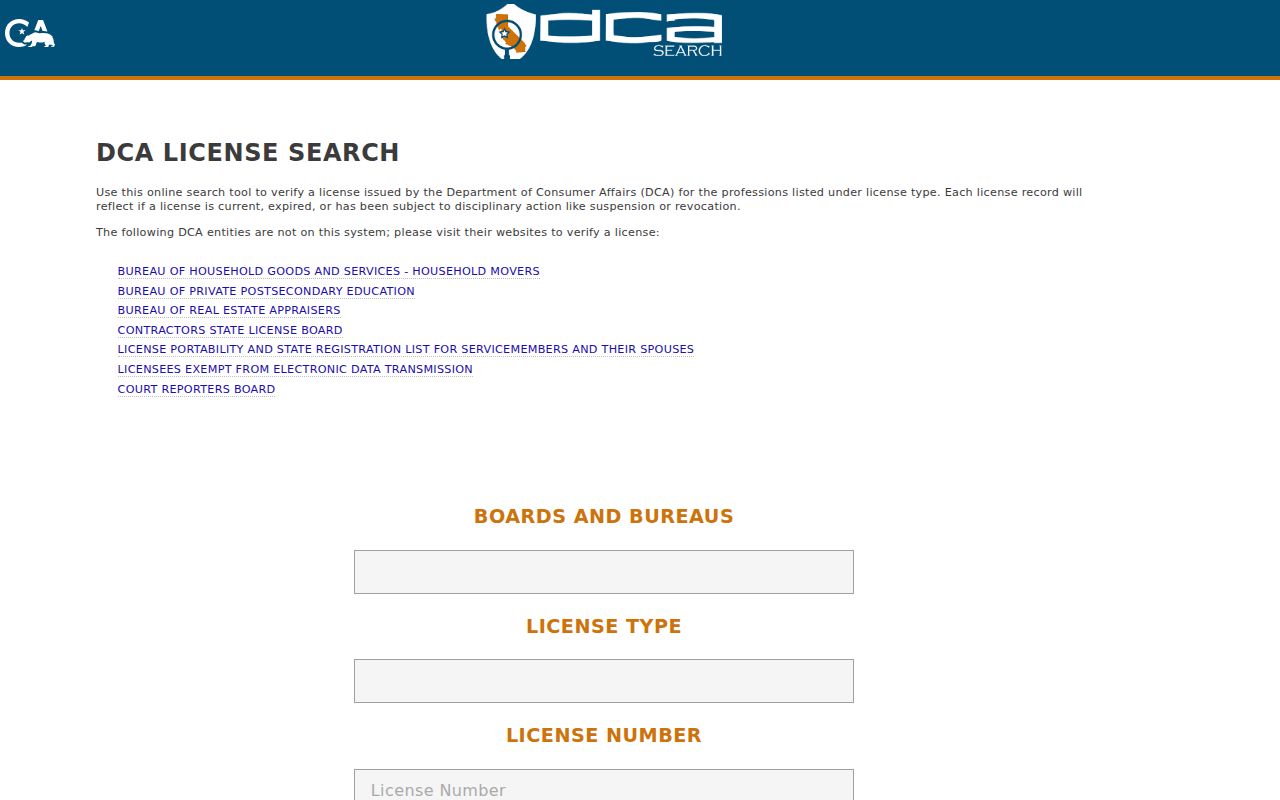
The license screen illustrates why a named board matters. It can confirm a credential record, but it does not confirm that the person lives in Albany or that every field is current.
For a company connection, California Secretary of State bizfile Online searches an entity name or number. Entity results can include the entity number, name, type, jurisdiction, status, formation date, agent or address information, and filing history where public. The agent for service of process is not automatically the owner, manager, or resident. Use the business filing to confirm a filed association, then seek a separate record for the individual fact.
The business search is especially useful when a name is tied to a company, but an entity filing remains a business record rather than a household directory.
Albany Vital Records and 2026 Fees
Vital records answer event questions, not open-ended name browsing. Alameda County Clerk-Recorder handles county births, deaths, and public marriages, while the California Department of Public Health handles statewide applications. There is no open certificate-image search. Established genealogy indexes, archives, and library databases may help locate a lead, but an official copy follows the form, relationship, sworn-statement, and payment rules for that record.
| CDPH certificate | 2026 fee and access point |
|---|---|
| Birth | $31. An authorized copy requires a qualified relationship and sworn statement; an informational copy is marked not valid to establish identity. |
| Death | $26. Authorized and informational copy rules differ; the exact form controls eligibility. |
| Public marriage | $19. County or CDPH ordering routes apply, with authorized and informational distinctions. |
| Divorce certificate | $18 for CDPH certificates covering 1962 through June 1984. The Superior Court holds the judgment and case file outside that certificate scope. |
The California vital-record forms cover VS 111, VS 112, VS 113A, VS 113B, and related applications. Common fields ask for the event type, number of copies, legal names, event date and county, parents' names or birthplaces where relevant, applicant contact details, relationship or authority, copy type, sworn signature, and payment. Mailed authorized-copy statements must be acknowledged or notarized. CDPH keeps the fee as a search fee when no record is found and may issue a Certificate of No Public Record.
Confidential marriage records are not a public index or general copy request. The county clerk can issue one to a party or under a court order. For divorce research, distinguish a CDPH certificate from the Superior Court file. Processing estimates change, so the live 2026 CDPH fee schedule and current application instructions should be checked before mailing a request.
Albany Resident Records and Old-Address Clues
Some people are easier to locate through a former address than a current name. The California State Controller's unclaimed-property search accepts a surname or business name with a given name, then allows city or ZIP narrowing. A result may show a holder-reported owner name and address fragment plus an official claim path. It can preserve an old Albany connection, but it is not proof of present residence, kinship, or the right to claim property.
The State Controller unclaimed-property search is the source for the image below. Search with spelling variants, then compare the result with a deed, obituary, probate record, directory, or other independent record before attaching it to one person.
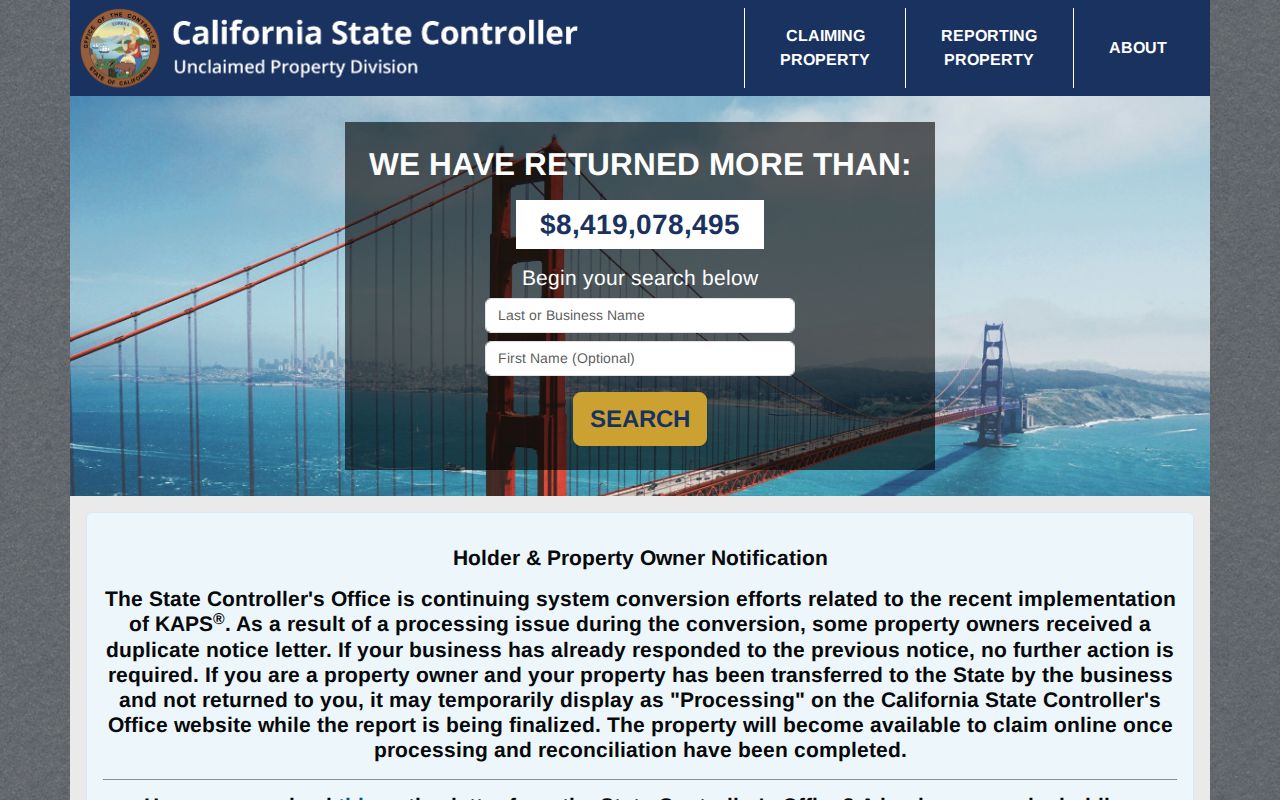
The result screen is a lead with a claim route, not an identity verdict. A holder-reported address fragment can point toward a past connection while still requiring a separate source.
For a family line, start with a confirmed death or obituary, then add probate, census, regional directories, deeds, cemetery material, and library genealogy databases. A former classmate or military friend may be better served by yearbooks, newspapers, Fold3, public professional listings, and consensual outreach. A birth-parent or heir question needs the official program or court process that controls the record. These human uses reward patient comparison, and they do not require publishing a current private address.
Albany Lookup Privacy and Safe at Home
California limits several paths that might otherwise look like a resident directory. A voter may verify personal status through My Voter Status or Alameda County's My Voter Profile, but voter rolls are not open for personal browsing. A statewide voter-file request requires an application, identity and contact details, the exact geography and fields requested, a qualifying election, scholarly, journalistic, political, or governmental purpose, security promises, and an acknowledgment of penalties. Signatures, Social Security numbers, and driver's-license data are not released.
Safe at Home gives eligible survivors and other people who fear for their safety a substitute mailing address, mail forwarding, an agent-for-service address, confidential voter registration, and possible DMV suppression or confidential name change. It does not erase old public records. Government Code section 6209.5 can permit a substitute address on certain deed or change-of-ownership forms, yet a property's legal description can still identify its location. Protected voter status and sealed, juvenile, confidential, or redacted court and vital records must be left alone.
When an existing Albany city or county record is not online, the Albany public-records request route is the fallback. The California Public Records Act, Government Code sections 7920.000 and following, lets any person request an existing, reasonably described record. An agency generally has 10 calendar days to determine whether responsive records exist, with a written extension of up to 14 days in unusual circumstances. Duplication costs and statutory fees may apply, and exemptions or redactions can protect private information. The request should name the department, person, address, record type, and date range without asking the city to create a new list.
Lawful use. An Albany resident lookup is for personal, lawful research, family history, civic understanding, and safety awareness. Do not use records to stalk, harass, threaten, impersonate, or publish sensitive details about another person.